 EN
EN


Balance naturally declines with age, making everyday activities like walking, standing, and climbing stairs increasingly challenging for older adults. A yoga ball offers a uniquely effective way to address this decline by introducing gentle, controlled instability that forces the body to engage deep stabilizing muscles. Unlike rigid gym equipment, a yoga ball responds dynamically to body movement, creating a training environment that closely mirrors real-life balance demands. This makes the yoga ball one of the most practical and accessible tools available for senior fitness programs.
Research consistently supports the use of yoga ball training as part of fall prevention and functional fitness routines for older adults. When seniors engage in yoga ball exercises regularly, they build stronger core muscles, improve postural awareness, and develop faster neuromuscular responses that help them recover from stumbles before a fall occurs. The yoga ball is not only effective but also low-impact and joint-friendly, making it suitable for older individuals with arthritis or reduced mobility. Understanding how and why the yoga ball enhances balance in this population is essential for trainers, caregivers, and older adults themselves.
The Science Behind Yoga Ball and Balance Training
How Instability Triggers Core Activation
The core benefit of the yoga ball for balance lies in its unstable surface. When an older adult sits, leans, or exercises on a yoga ball, the body cannot rely on passive structural support. Instead, it must continuously recruit deep postural muscles, including the transverse abdominis, multifidus, and pelvic floor, to maintain equilibrium. This constant activation strengthens muscles that are rarely targeted through conventional floor-based exercises. For older adults who have experienced muscle loss through aging, this kind of recruitment is especially valuable.
Every yoga ball movement also sends rich sensory feedback through mechanoreceptors in the joints and skin. This sensory input travels to the brain and helps recalibrate the body's proprioceptive system, which is the internal sense of body position in space. Proprioception weakens significantly with age, and this deterioration is one of the primary contributors to falls in older populations. Regular yoga ball training helps restore and maintain this critical sensory pathway, giving the nervous system more accurate information to act on during balance challenges.
Neuromuscular Benefits for Aging Bodies
Beyond muscle strength, the yoga ball trains neuromuscular coordination, which refers to how efficiently the brain and muscles communicate during movement. Older adults often experience delayed reaction times that reduce their ability to self-correct mid-movement. The yoga ball creates frequent micro-challenges that train the body to respond faster and more accurately. Over weeks of consistent yoga ball practice, older adults typically show measurable improvements in both static balance, such as standing still, and dynamic balance, such as walking on uneven surfaces.
Effective Yoga Ball Exercises for Older Adults
Seated Stability and Core Work
One of the safest entry points for older adults is seated yoga ball work. Simply sitting upright on a yoga ball while maintaining neutral spine alignment activates the core and promotes postural awareness. From this position, seniors can progress to gentle pelvic tilts, marching in place, or lateral weight shifts, all of which further challenge the stabilizing system. These seated yoga ball exercises are ideal for individuals who are new to balance training or who have limited lower-body strength.
Adding arm movements while seated on a yoga ball introduces additional coordination demands. Reaching forward, to the side, or overhead while balanced on the yoga ball forces the body to recalculate its center of gravity with each motion. This mirrors the real-life situation of reaching for objects while standing, a common moment when older adults lose balance. Practicing this movement pattern on the yoga ball builds the specific neuromuscular habit needed to stay stable during such everyday tasks.
Standing and Supported Movement Exercises
For older adults with better baseline fitness, standing yoga ball exercises offer a higher level of challenge. Wall-supported squats using a yoga ball placed between the back and the wall combine lower-body strengthening with balance demands. The yoga ball rolls gently as the individual moves through the squat, requiring constant muscular adjustment. This exercise strengthens the quadriceps and glutes while simultaneously training the stabilizing muscles of the hips and ankles, all of which are critical for fall prevention.
Yoga ball leg lifts, where the ball is held between the hands or placed behind the back while performing small leg raises, train both the hip flexors and the core under balance conditions. These yoga ball movements gently challenge coordination and reinforce proper postural alignment. For older adults recovering from injury or managing chronic joint conditions, these supported yoga ball exercises allow progressive loading without placing excessive stress on vulnerable structures.
Integrating the Yoga Ball into a Senior Fitness Routine
Frequency, Progression, and Safety
To gain meaningful balance benefits, older adults should aim to include yoga ball exercises at least two to three times per week. Consistency is more important than intensity at this stage of training. Each session can begin with five to ten minutes of seated yoga ball stabilization before progressing to more dynamic movements. A structured yoga ball program that gradually increases challenge over time is more effective than sporadic high-intensity practice.
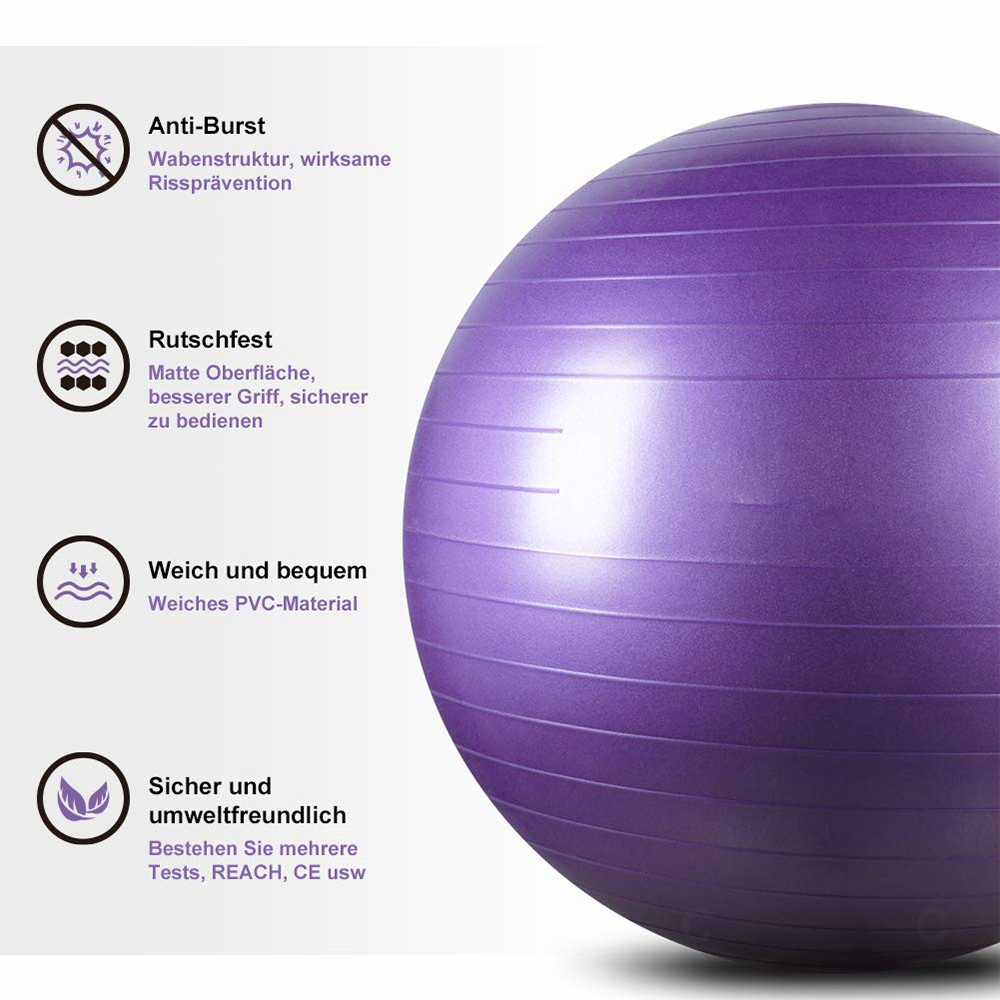
Safety is a priority when introducing a yoga ball to older adults. The ball should be properly inflated so that hips align parallel with or slightly above the knees when seated. A non-slip yoga ball surface reduces the risk of slipping, and sessions should always begin near a wall or stable surface for support. Trainers and caregivers should monitor form carefully, especially in the early stages, to ensure the yoga ball is providing challenge without creating fall risk. Selecting the correct size yoga ball based on height ensures proper biomechanical alignment throughout every exercise.
Long-Term Balance and Quality of Life
The long-term value of yoga ball training extends beyond physical fitness. Older adults who engage regularly with a yoga ball often report greater confidence in their movement, reduced fear of falling, and higher overall activity levels. This psychological benefit is significant because fear of falling frequently causes older adults to reduce activity, which accelerates physical decline. A consistent yoga ball practice interrupts this cycle by building genuine physical capability and self-assurance. The yoga ball becomes not just an exercise tool, but a gateway to more active and independent living for seniors.
FAQ
What size yoga ball is best for older adults working on balance?
Size selection depends primarily on the user's height. A 55 cm yoga ball suits individuals between 5'0 and 5'5, while a 65 cm yoga ball works well for those between 5'6 and 6'0. The correct yoga ball size ensures the hips remain level or slightly elevated above the knees when seated, which supports safe spinal alignment during all exercises.
How long does it take for a yoga ball routine to improve balance?
Most older adults begin noticing improvements in stability and coordination within four to six weeks of consistent yoga ball practice. Measurable gains in proprioception and postural control are typically observed when yoga ball exercises are performed at least twice per week with progressive difficulty increases over time.
Is a yoga ball safe for seniors with osteoporosis or joint pain?
A yoga ball is generally considered safe for older adults with osteoporosis or mild joint conditions because it offers low-impact, non-compressive movement. However, individuals with severe osteoporosis or significant balance impairment should consult a healthcare provider before starting a yoga ball program. Using the yoga ball near a wall or with a spotter adds an important safety layer for vulnerable users.